Parenting a sparkler

20130822-180346.jpg 20130904-225559.jpgBefore I had Jacob, I didn’t believe in colic. I thought it was a made-up word for a fussy baby, and that “fussy” meant a baby’s needs were not being met. I know a lot of people who still feel that way.
Until I had one of those babies.
Jacob was the most calm, quiet baby in the first few weeks. I actually recall (I am cringing as I type this) wondering aloud why other parents made such a big deal about this whole newborn thing. It’s so easy! [Go ahead, throw something at the monitor. It will make you feel better, and it’s not my monitor.]
Of course, my baby was a jaundiced baby. He was lethargic, sick. Once he woke up, he was a very different baby. He screamed. A lot. Thankfully for me, there was a solution, and that solution was never putting him down. Now, before you decide that never putting him down is a mommy problem, let me assure you that I looked into EVERY OTHER THING. Maybe it was his tender little belly, and so maybe he felt better upright, cradled against me. Thankfully I discovered babywearing, which allowed me to do semi-normal things like a semi-normal person. Maybe it was the fourth trimester, and therefore my job to make his life as womblike as possible. Or maybe, just maybe, I have a sparkler.
From The Womanly Art of Breastfeeding, La Leche League International:
Maybe you’ve got a sparkler–an intense, sensitive baby who needs input, input, input! His only settings are high and off. That’s the downside. The upside is how truly bright and curious he is likely to become. You’ll work hard as a mother to this baby. Look for other mothers of sparklers, to share notes with. Keep your sense of humor and try not to compare your busy days with those of your placid-baby friends. And keep your little sparkler close to you–your presence and touch will often go a long way toward calming him.
I read this at a time that I figured our sparkly days were at an end; after all, he was quickly approaching toddlerhood and could no longer be considered any kind of baby! I was confused when, at 21 months (that’s a year and three-quarters for those of you who aren’t so great with math) he is still intense. INTENSE. And sleeping poorly. Picky about napping. When he is sick I get the ultimate show of his worldview: it’s all “mama” all the time. I mean, I can’t even go to the bathroom without him. Well, folks, sparklers can develop into what Dr. Sears calls “high-need children.” I don’t like this title as much because: 1. yuck on labels 2. sparkler was cute, sparkler was like sparkles, and who doesn’t like sparkles? 3. it sounds like “special-needs” and I feel that this is confusing. So read this article about the 12 features of a high-need baby.
In case you didn’t feel like doing that, I’ll summarize: it’s not special needs, just a more sensitive, exacting baby. He is intense, driven, and smart. As a small baby he was not easy to soothe, and needed to be held a lot. He cried, and there were times that I just didn’t know why. As a toddler, he knows what he wants and he has to have it. He is also curious and helpful. He makes connections between things he sees in a very sophisticated way for his age. He is very determined. He is also really in tune to the people around him. He is sad when they are sad. He tries to comfort other children when they cry. I hope this is the beginning of empathy, which is my main parenting goal at this stage. I believe that raising a generation of more empathetic children will actually make the world a better place.

Because these children are so sensitive, they develop great discernment and are able to consider the effects of their behavior on the feelings of others. They are able to achieve one of the ultimate qualities of self-discipline: the ability to think through what they’re about to do.

(From the Dr. Sears article linked above)
I believe that these qualities will work out well for Jacob, but he is a lot of work now. I also believe that it is no coincidence that he was given to a stay-at-home mom. A high-needs child would have a difficult time in day care, or dealing with frequent schedule changes. I know that in his first six months he really needed a lot of “touch time” with me, and there would have been no substitute.
He knows more words than I can count, he understands everything, he kisses my boo-boos and hugs me when I am sad. Sometimes I make him so happy that he grabs on to me with all the strength in his body and even rips out some of my hair. He is amazing.
But he is not easy.
There are times that I gaze over at the “easy” baby and I wish for a minute that my days were spent having fun and doing solo crafts during naptime, but that is just not in the cards for me. He is an “over-the-top” baby. Everything he does is an accelerated version of what other babies do. Of course, I believe that someday this will all pay off for Jacob, and I’ll be doing something incredible with my incredible sparkler.
I wouldn’t change him, given the option. But I might add some hours to my day and sleep through them.
Posted in Uncategorized | Tagged , , , , , , , , , , , , , | 7 Comments

How to get through: Sanctification

Sanctification: How God turns bad to good

Joy versus happiness: we all want to be happy, but do we strive to be joyful? Happiness is external. An ice cream cone can make you happy. Joy, on the other hand, is internal. How do we experience joy? Through sorrow.

sanc·ti·fy

ˈsaNG(k)təˌfī/
verb
verb: sanctify; 3rd person present: sanctifies; past tense: sanctified; past participle: sanctified; gerund or present participle: sanctifying
  1. set apart as or declare holy; consecrate.
    free from sin; purify.
    To make me like you

    God’s main purpose in our lives is to make us like Jesus. He wants you to possess love, joy, peace, patience, gentleness, kindness, faithfulness, and self-control. Those are the qualities He wants for you.

We are taught through opposites; pain teaches us pleasure, sorrow teaches us joy. To teach us to love, we will be surrounded by people who are hard to love (does that sound familiar?). He uses:

  1. His Holy Spirit
  2. His word
  3. other people
  4. problems (pressures/pain/suffering)

Every problem has a purpose. We are transformed by our troubles. There is a reason for everything.

At this point, Pastor Warren said that he would read us a verse that is one of the most amazing and most misunderstood passages in the Bible.

28 And we know that God causes everything to work together for the good of those who love God and are called according to his purpose for them. 29 For God knew his people in advance, and he chose them to become like his Son, so that his Son would be the firstborn among many brothers and sisters.
Rom 8:28-29

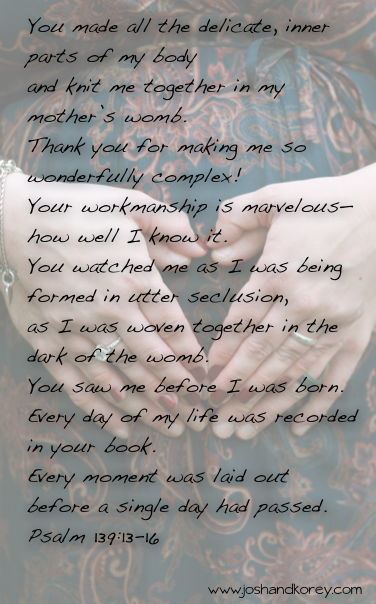
God planned you as He plans all things. See my favorite verse for reinforcement:

psalm 139

He causes all things to be. This idea can be confusing. Does God cause bad things to be? Why isn’t everything good if God plans it all?

Not everything is good, but God causes it to work together for good.

The world is broken, and its inhabitants have free will. As with the struggle with Jacob, our freedom to make our own choices is important to God. That explains why there is so much bad in the world. When He made plans for our lives, He did not stop bad things from happening, but He did cause every thing to work together for good.

We know that these troubles produce patience. And patience produces character…

Rom 5:3-4

Opposites teach us what we know of the main qualities in life. What is happiness without sadness? What is joy without sorrow? Is not happiness measured in the amount that it differs from sadness? What is dark without light?

Instead of asking “why is this happening?” ask “what can I learn?”

Every event in your life is an opportunity for growth.

You are exactly where God wants you to be

This is the great lesson of the wonderful book The Alchemist by Paulo Coehlo; that you should trust that you are just where you need to be. Even those times that feel like setbacks, missteps, even the times you think you are lost, each and every moment has a purpose and is part of the plan for your life. When you find yourself in a dead-end job and you lament that you are wasting your life, no time is being wasted. You are being held in that moment until you learn what it needs to teach you. Sometimes God “boxes you in” to a situation until you learn what you need to know. No one ever said the path of your life would be straight and simple; the detours are as important as the distance.

Another wonderful passage that I learned about in Bible Study last year: Jacob’s son Joseph goes from favorite child to prisoner. He is thrown in a pit by his brothers, sold into slavery, falsely accused of a crime and imprisoned. It seems as though his life is being wasted with bad luck. When he is reacquainted with his brothers he is the Pharaoh’s main advisor. He is powerful and well-respected, even feared. His brothers fear that he will want retribution for how they tried to ruin his life. He says:

You intended to harm me, but God intended it all for good. He brought me to this position so I could save the lives of many people.

Gen 50:20

So when you are feeling lost or ruined, how do you respond?

1. Remember that God’s plan is good

2. Rejoice and give thanks

3. Refuse to give up

There is a lesson and a plan in everything. Are you lost, or are you being shown a better path? Are you stuck, or are you being held in place for a lesson? It is in your hands to do something about this. YOU need to find the lesson, the significance. YOU need to find the significance in each moment.

You could pray:

“God, make this easy” or “God, make this for good.”

“Comfort me” or “Conform me”

What you choose is your choice.

Watch this sermon (from Rwanda!) here.


Posted in Uncategorized | Tagged , , , , , , , , , , , , , , , , , , , , , , , | 1 Comment

How to get through: Surrender

Surrender: How to experience peace

Screen Shot 2013-09-08 at 10.15.04 PM

When bad things happen, you have three choices. You can let it:

  • Destroy you
  • Define you
  • Develop you

Steps of Surrender

1. Accept what cannot be changed.

Yes, it’s part of the Serenity Prayer for a reason.

What do you  need to accept as over in your life? Are you stuck in denial?

 2. Remember, it’s not the end of the story.

Are you going to let grief define you?

3. Take care of yourself

The act of resuming the care of your physical body is symbolic of your decision to go on living. Sure, you’re in the depths of despair, but the day that you decide to eat, wash your clothes and body, and go for a walk is the day that you know you will survive–and if you’re going to survive you’ll need nourishment and hygiene.

4. Refocus on God through worship

The temptation is to run from God, thinking He is responsible, but it’s not a long-term solution. Seek a quiet place where you can think.

5. Do something productive

When you are ready to surrender, you realize that life does go on, even in the midst of pain, and you are able to do something productive. It will make you feel a semblance of normalcy — you’ll be human again. Return to routine.

You don’t have to stop mourning to stop moving

Grief doesn’t paralyze; fear does.

6. Keep on loving, even in your pain

Redirect your pain. Focus on loving those around you. Especially in times of loss, you are surrounded by loved ones who are grieving along with you. Refocus your energy on helping them feel loved, and it will lessen the sting of your own pain.

Love = pain

Pain deepens your love

Look at what you have left, not what you lost

love until it hurts

Watch this sermon here.

Posted in Uncategorized | Tagged , , , , , , , , , , , , , , , | Leave a comment

How to get through: Struggle

Struggle: when you don’t understand

Building on the discussion about sorrow, the next stage is struggle. Our tendency is to push things down and avoid dealing with him. Dealing with those difficult things will make us sad, it will be hard…and that is exactly why we shouldn’t allow them to fester inside. We also need to feel comfortable in our lamentation. It’s okay to be mad about the situation you’re in. You can dislike the changes that have occurred in your life. Struggling with them will bring you closer to acceptance and healing. Know throughout your struggle that there is hope.

In Genesis, Jacob, the man who will be known as the father of Israel, struggles with God. In fact, he actually wrestles with God. When I read this story in Bible Study, it made no sense to me at first. Jacob is returning to his homeland with his large family of two wives, many children, servants, and animals. His brother is a leader in this land and his brother, Esau, also wants to kill him. He is scared for his life. He sends his family on ahead in case Esau catches up with him. That night, a man comes to his camp and wrestles with him until daybreak. They are pretty evenly matched, and Jacob will not give up. Finally, the man breaks Jacob’s hip. Jacob still will not give up. He demands a blessing from the man. The mysterious stranger asks for Jacob’s name; his name, which means “usurper” for Jacob has stolen his older brother’s birthright. The stranger tells Jacob that his name will now be Israel because he had struggled with God and man and overcome. Jacob goes on his way, limping, and names the place where he wrestled with the man to reflect that he had seen “the face of God and yet was spared.”

Confusing, right? The mysterious stranger was God (or an angel, or Jesus, the incarnation of God). He wrestled with Jacob because Jacob was struggling, and he needed to take his struggle right to God. Why did God continue to wrestle with him through the night? Why not just overpower him immediately? To give us free will. God wants you to struggle with Him, because it gets you close to Him, face to face. The struggle is an important part of the process. Don’t just ignore how you’re feeling in an attempt to be polite or non-offensive. Talk it out. Ask questions. Wrestle with Him.

Jacob had really tried to be a good man, and to do right by God, but like all of us, he was human. He made a lot of mistakes. In fact, he did some really terrible things. In the end, he is the father of Israel. He is named Israel. He is buried in the Holy Land with all the pomp and circumstance of a pharaoh. Even when he struggles with God he is loved and rewarded. His struggle brings him closer to God than ever before.

There is hope for you yet.

Watch this sermon here.

*In case you’re wondering, here is the Bible passage from NIV:

Jacob Wrestles With God

22 That night Jacob got up and took his two wives, his two female servants and his eleven sons and crossed the ford of the Jabbok. 23 After he had sent them across the stream, he sent over all his possessions. 24 So Jacob was left alone, and a man wrestled with him till daybreak. 25 When the man saw that he could not overpower him, he touched the socket of Jacob’s hip so that his hip was wrenched as he wrestled with the man. 26 Then the man said, “Let me go, for it is daybreak.”

But Jacob replied, “I will not let you go unless you bless me.”

27 The man asked him, “What is your name?”

“Jacob,” he answered.

28 Then the man said, “Your name will no longer be Jacob, but Israel,[f] because you have struggled with God and with humans and have overcome.”

29 Jacob said, “Please tell me your name.”

But he replied, “Why do you ask my name?” Then he blessed him there.

30 So Jacob called the place Peniel,[g] saying, “It is because I saw God face to face, and yet my life was spared.”

31 The sun rose above him as he passed Peniel,[h] and he was limping because of his hip. 32 Therefore to this day the Israelites do not eat the tendon attached to the socket of the hip, because the socket of Jacob’s hip was touched near the tendon.

Posted in Uncategorized | Tagged , , , , , , , , , , | Leave a comment

Quinoa-stuffed gypsy peppers

I received gypsy peppers in my last CSA box. Now I think gypsy peppers are some sort of hybrid, but all you need to know is that they are smallish mild chiles, not spicy, rather sweet. Any mild chile would work, even a bell pepper would work, although I’d get orange or yellow.

Ingredients:
Chile peppers
Quinoa, 1 cup
Monterey Jack cheese, cut into small cubes
Chicken broth
Cilantro
1 ear of corn, kernels cut away
Pine nuts, as many as you can afford 😉

Directions:
Cook quinoa according to package directions, using chicken broth in place of water. (1 C. Quinoa to 1.25 C. water/broth)
Remove tops of peppers and with a small paring knife, cut out any remaining seeds.
Mix together all ingredients in medium bowl. Holding a pepper over the bowl, stuff with a small spoon. Wrap each pepper in foil, making sure to enclose the cut and open top. Bake at 450 for 15 minutes or grill. Skin should be lightly brown in spots and soft. You can also open the foil for the last minute or two if you like the really roasted flavor.
Enjoy!

20130911-221047.jpg

20130911-221056.jpg

Posted in cooking, recipe | Tagged , , , , , , , , , , , , , , , , , | Leave a comment

LaLa

20130904-225926.jpg

20130904-225935.jpg

Posted in daily baby | Tagged , , , , | Leave a comment

How to get through: Sorrow

Sorrow: when your heart is breaking

The second part of the “Get Through” series was so powerful to me. The topic was sorrow. As Americans, we downplay sorrow. We are the self-made man, pulling himself up by his bootstraps; that man doesn’t have time to cry. Men, especially, are taight that shows of sadness are effeminate. Women are reminded that sadness is unprofessional. And so we take our grief and we stuff it deep down inside, and we put on a composed face, and we are praised for our bravery. The true bravery, however, lies in being honest with one’s emotions. Grief is important. It is Biblical. It is human.

You don’t ever get over grief, you get through it.

Let’s explore…

1. Loss is unavoidable, but grief is a choice.

There is no life without change

There is no change without loss

There is no loss without pain, but grief is a choice

You choose how to react to loss or change. Most of us choose “bravery” or, actually, pretending that we are doing better than we really are. In this process, we do not let ourselves truly grieve, and we get stuck, because…

2. Grief is healthy.

Grief is, in fact, the only healthy response to loss. It is not embarrassing, effemiate, or unprofessional. It is a truly productive emotion. Grief was designed to help us make a transition. For the same reason that it is vital for human beings to throw parties and celebrations at big, life-changing times (graduations, weddings, funerals, bachelor parties): we need to mark the end of one thing and the start of another. Life is changing, and if we act as though nothing has changed, we aren’t dealing with the complex emotions that come with the change. We were designed to release emotion this way–humans cry! It’s a physiological response to a mental process. Take a moment to soak in the power and enormity of that. A mental process, an emotion, drives our bodies to create tears, to breathe differently, to cry. Incredible.

Sadness is not weakness

Our reactions to sorrow usually involve repression or suppression (unconsciously or consciously blocking out painful ideas). Unfortunately for us, when we swallow our emotions, our bodies reject them. Think acid reflux, ulcers, anxiety, insomnia, and more.

If I don’t let it out, I’ll act it out

Grieve appropriately, or you may find your grief leaking into and contaminating other areas of your life.

3. God grieves with me.

Grief is human, and humans were made like God. He weeps and mourns with us. In the Bible, you will find Jesus crying and mourning.

4. Grief is healed in community.

We need to share the burdens and sorrows of others, just as we should share in their joy (Gal 6:2, Rom12:15).

You need fellowship when you want it the least.

5. Grief takes time.

There is no rushing this process. Every grief is different. You cannot dictate when someone should “be over it” (also see above – you’re never over it!). Grief is a season, just as any other. It has its time, and it will end when it is finished.

There is a time for everything, and a season for every activity under heaven…a time to weep and a time to laugh, a time to mourn and a time to dance.

Eccles. 3:1,4

Comparing never comforts!

Once you have decided that your grief is a useful tool in your growth, how do you move forward?

1. List the losses you’ve never grieved

Dig deep. What do you hold on to that needs to be explored? What have you stuffed deep inside and allowed to poison you?

Wounds won’t heal unless you clean them out

That sounds painful, and it probably will be. But it is necessary for moving forward. Acknowledge that it is fear that prevents us from grieving. Fear of embarrassment, or pain, or negative repercussions, or all of those.

But did you know that “fear not” is in the Bible 365 times? One time for each day. 🙂

2. Identify what you’ve really lost

Was it opportunity? Love? Comfort? Companionship? Hope? Once you know what you have lost, you know what you need to grieve.

3. Have the courage to lament.

A lament is a passionate expression of grief. Americans do not do this well. Let it out.

4. Ask Jesus to heal your broken heart

I mean…it’s His job.

This can be applied to anything that has hurt you…not just loss or death. Perhaps you never really healed the pain of being bullied when you were young. Maybe you just lost your job. Perhaps you feel that your dream of being married will never happen…these are all losses to your psyche that should be grieved. Give them the attention they deserve and demand. Clean them out and let them heal.

Watch the sermon here.

Posted in Uncategorized | Tagged , , , , , , , , , , , , , | Leave a comment

Evening stroll

20130904-225448.jpg

20130904-225456.jpg

20130904-225509.jpg

20130904-225546.jpg

20130904-225559.jpg

20130904-225614.jpg

20130904-225624.jpg

20130904-225634.jpg

20130904-225643.jpg

20130904-225657.jpg

20130904-225706.jpg

Posted in daily baby | Tagged , , , , , , , , , , , , , , , | Leave a comment

Glitter ombré nails – reverse edition

20130904-225315.jpg

Posted in Uncategorized | Tagged , , , , , , , | Leave a comment

How to get through what you’re going through, a series at Saddleback Church

I have really wanted to recap some of the amazing things I’ve learned in the series about getting through at Saddleback Church. I’m sure everyone in the free world knows that Pastor Rick Warren’s son committed suicide in April. He returned after a four month leave and is teaching a series on getting through hard times, and it’s been really powerful. 

He outlines 6 stages of grief: Shock, sorrow, struggle, surrender, sanctification, and service.

In this post I’ll discuss what I learned about the first stage.

Shock: When your world collapses

When you first receive the bad news, you do not know how to respond but to say “no.” You refuse to believe it. This is also referred to as the “denial” stage, but he calls it “shock.” You can’t accept what has happened, nor can you complete basic tasks. You need PEOPLE. You need a support system. He said that his small group came to his son, Matt’s house to stand on the driveway with Rick and his wife as they waited for law enforcement personnel to finish their assessment. They followed the Warrens home and stayed the night. They brought meals and did laundry — all things you can’t think about doing when your world has been turned upside down.

He gave some important pointers for every one of us as we comfort those who are in shock, or grieving. The most important was to “show up and shut up.” If you’ve had a traumatic life experience and been turned off by the support offered by others when it comes in the form of “understanding what you’re going through” then you understand why it’s so important to shut up. The family doesn’t need to hear that you understand their pain. There are no magical words that will make it better. They just need your presence. Offer to listen, and don’t say a word. Also, we often offer assistance in the form of “let me know what I can do,” and then we are surprised when the person never asks for anything. “Well he must not need anything” you think. Wrong. Don’t make a grieving person reach out and ask for help; just be there and do it.

He stressed the importance of human connection, and having a support system. He suggests that this support system lie outside your family.  This makes sense. His grief was shared by his entire family, so how could they support one another while grieving the same, terrible, loss? His small group provided this comfort for him, but it made me really think about my community, my village. Am I the type of support person that waits to be asked? Or do I show up and fill in the gaps? Moving forward I will focus on more doing, less talking.

Listen to the service here.

Posted in Uncategorized | Tagged , , , , , , , , , | Leave a comment